Kitchen Countertops in Vancouver, WA: Porcelain, Tile, Quartz and Stone
September 28, 2026 · All About Floors NW
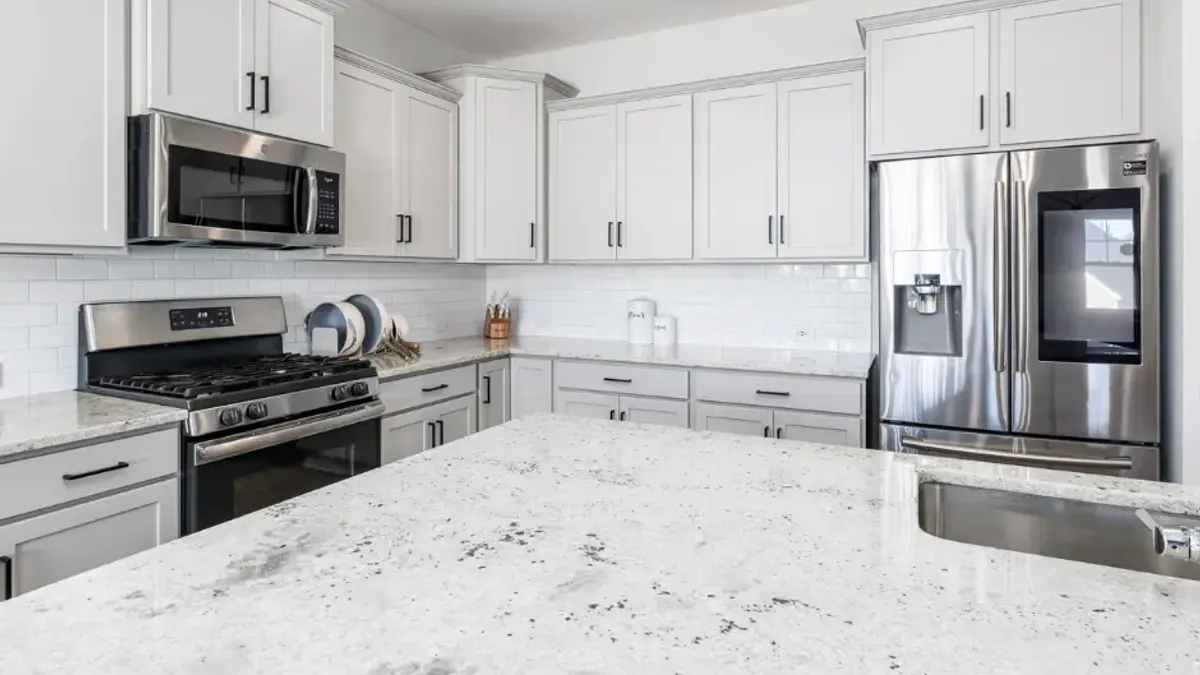
New kitchen countertops change more of a kitchen than any other single upgrade except the cabinets. The surface you pick decides how the room looks, what you can set down on it without thinking, and how much looking after it needs for the next twenty years. It also decides what happens to the backsplash, and often the floor.
Most countertop guides compare quartz and granite and leave it there. We cover those in our guide to choosing a countertop material. This guide covers what Vancouver homeowners ask us about most when they are planning a kitchen: porcelain slab and modern tile countertops, how they compare with quartz and stone, what actually drives the price, and how to plan counters, backsplash and floor as one project instead of three.
The four countertop surfaces we install
We install four kinds of countertop. Each one suits a different kitchen.
Porcelain slab: the one most people have not considered
Porcelain slabs are large, thin panels of the same dense, fired material as porcelain floor tile, made big enough to cover a countertop run with few or no seams. They have become one of the most popular countertop materials in Europe and are catching up fast here.
What they do well:
- Heat. Porcelain is fired at very high temperatures, so a hot pan will not scorch or discolor it the way it can quartz. Trivets are still a good habit, but a slip will not ruin the counter.
- Stains. It is essentially nonporous and never needs sealing. Wine, coffee, oil and turmeric wipe off.
- Sunlight. Porcelain is UV-stable, so it will not yellow near a sunny window. That also makes it suitable for covered outdoor kitchens.
- Looks. The printed surfaces are very convincing, especially the marble looks. You get the look of Calacatta without marble’s etching and staining.
The tradeoffs are real too. Porcelain is hard but thin, so the edges and corners are the vulnerable points, and a heavy pot dropped on an edge can chip it. Edge profiles are more limited than with stone, and cutting and setting large slabs is specialist work. Installed well, it is one of the lowest-maintenance surfaces a kitchen can have.
Tile countertops: modern tile, not your parents’ kitchen
When people hear “tile countertop” they picture 4-inch squares with wide, dingy grout lines. That is not what tile counters look like now.
Modern tile countertops use large-format porcelain, often 24 by 48 inches or bigger, with tight joints and stain-resistant grout. There are far fewer grout lines, and the ones that remain do not soak up spills the way old cement grout did. Tile is our specialty, and it has advantages no slab can match:
- Cost. It is usually the most affordable hard, heat-resistant countertop.
- Repairability. A cracked tile can be cut out and replaced. A cracked slab means a new slab.
- Design freedom. Any color, pattern, edge detail or combination, and the counter can be matched exactly to the backsplash or the floor.
- Fit. Tile goes into awkward spaces, such as angled counters, bars and built-ins, without the logistics of moving a giant slab.
Tile is an especially good choice for bathroom vanities, laundry rooms, outdoor kitchens, rentals and bars. In a main kitchen it suits people who value repairability and custom design over a seamless look.
Quartz: the low-maintenance default
Engineered quartz is still the most requested kitchen countertop, and for good reason: it is nonporous, consistent from slab to slab, never needs sealing, and is tough at the edges. Its weak spots are heat, since a hot pan can leave a mark, and direct sunlight, which can yellow some colors over time. It suits almost any kitchen where you want to stop thinking about the countertop.
Granite and natural stone: one-of-a-kind, with upkeep
Every granite slab is unique, and nothing engineered quite reproduces that depth. It is heat-resistant and very hard. It is also porous to varying degrees and needs periodic sealing. Marble is softer again and etches on contact with lemon juice or vinegar. Both are beautiful. Choose them knowing what the upkeep is. Our countertop materials guide goes deeper on quartz and stone care.
Kitchen countertop materials at a glance
| Porcelain slab | Tile | Quartz | Granite | |
|---|---|---|---|---|
| Heat resistance | Excellent | Excellent | Fair; use trivets | Very good |
| Needs sealing | No | Grout, depending on type | No | Yes, periodically |
| Stain resistance | Excellent | Good, best with urethane or epoxy grout | Excellent | Good when sealed |
| Seams | Few | Grout lines throughout | Few | Few |
| Repairable in place | Limited | Yes, single tiles | Limited | Limited |
| Relative cost | Mid to high | Lowest | Mid to high | Mid to high |
What actually drives the cost of kitchen countertops
Countertop prices are quoted in many ways: per square foot, per slab, per linear foot or as a lump sum. That makes comparing quotes harder than it should be. Whatever the format, the total is driven by the same things:
- The material and the specific product. A plain quartz or porcelain costs far less than a heavily veined designer slab. Tile ranges from economical ceramic to premium porcelain.
- How many slabs the layout needs. An island that is a few inches too long for one slab can mean buying a second slab.
- Cutouts. Sink, cooktop, faucet and soap-dispenser holes each add labor, and undermount sinks cost more than drop-ins.
- Edge profile. A simple eased edge is standard. Mitered edges, which make a thin slab look thick, take much more work.
- Tear-out and disposal of the old counters, and whether the old backsplash comes off with them.
- Backsplash. Full-height slab backsplashes, tile backsplashes and short 4-inch splashes are priced very differently.
- Plumbing. Disconnecting and reconnecting the sink, faucet and disposal, and whether a new sink is part of the job.
- Cabinet condition. Slab counters need level, solid cabinets. Out-of-level or damaged boxes need shimming or repair first.
When you compare quotes, ask each one to list those items separately. The difference between two countertop bids is usually in the edges, cutouts, backsplash and plumbing rather than the material.
Plan the backsplash with the countertop
The backsplash is where countertop decisions either come together or clash. Pick the counter first, then the backsplash, because the counter is the larger, more expensive surface with fewer options.
A few combinations that work well in Vancouver kitchens:
- A full-height porcelain slab backsplash that matches the counter. It is seamless, easy to wipe and dramatic behind a range. It costs more, but there is no grout to clean.
- A busy, veined counter with a quiet backsplash. Let one surface lead. A strongly veined marble-look porcelain pairs best with plain white or soft-toned tile.
- A plain counter with a patterned backsplash. A solid quartz or simple porcelain leaves room for handmade-look zellige, a herringbone mosaic or a bold color on the wall.
Because we install tile backsplashes as well as countertops, the grout color, tile edges and outlet placement are planned together, and the counter and backsplash are installed in the same visit.
Counters, backsplash and floor as one project
If you are redoing counters, it is the natural time to look at the floor too. The kitchen is already out of action, the appliances are already moving, and doing it all at once avoids damaging a brand-new floor or countertop with the second project.
The planning points that matter:
- Does the new floor run under the cabinets or stop at them? That decides the order of work, finished counter height and whether the dishwasher still slides out.
- Appliance clearances. A thicker floor under a dishwasher can trap it under the new counter.
- Coordinated materials. Counter, backsplash and floor should work together in value and undertone, and seeing all three samples side by side is far easier than guessing.
For the flooring side, our guide to kitchen flooring in Vancouver covers what holds up to spills, dropped pans and long hours at the sink. If the kitchen opens into living areas, waterproof flooring options are worth a look too.
The countertop replacement timeline
Plan for this sequence:
- Estimate and selection. We measure, look at the cabinets and plumbing, and bring samples so you can choose in your own kitchen light.
- Tear-out. Old counters and, usually, the old backsplash come off. The sink is disconnected.
- Template (slab counters). Walls are never quite straight, so porcelain, quartz and stone are templated in place after the old tops come off, and the slabs are cut to that template. Plan on roughly two weeks between template and install, and set up a temporary kitchen for that stretch.
- Install. Slab counters usually go in within a day. Tile counters are set on site over one to three days, and then the grout and sealer need time to cure.
- Backsplash and plumbing. The backsplash goes in once the counters are set, and the sink and faucet are reconnected.
Kitchen countertops from All About Floors NW
We have been installing tile, stone and flooring in Clark County since 1999, and we added countertops because so many kitchen and bath projects needed all three. Our team handles substrate prep, waterproofing, layout, grouting and sealing, from demolition to the finished surface.
- Materials: tile, large-format porcelain slab, quartz and natural stone, plus coordinating tile backsplashes. See them on our countertops page.
- One project, one schedule: counters, backsplash and tile, luxury vinyl plank or hardwood floors planned and installed in the right order by one company.
- Samples at full size. Visit the showroom at 6700 NE 152nd Ave #140 in east Vancouver, Monday through Friday, 9 to 6, or have us bring samples to your kitchen.
- Workmanship warranty on every installation, and financing for qualified buyers through our financing options.
We install countertops in Vancouver, Camas, Washougal, Battle Ground, Ridgefield, Salmon Creek, Hazel Dell, Portland and Gresham.
Book a free in-home estimate, or text a photo of your kitchen to (360) 525-2962 and tell us what you are thinking about. We will tell you which surfaces make sense for how you cook.
Related reading
Frequently asked questions
- What is the most durable kitchen countertop?
- For everyday kitchen abuse, porcelain slab and quartz are the two most durable choices. Porcelain is the more heat- and UV-resistant of the two: a hot pan will not mark it and sunlight will not fade it. Quartz is slightly more forgiving of impact at the edges. Granite is also very durable but needs periodic sealing. Tile is tough, but the grout lines are the weak point.
- Are porcelain slab countertops a good idea?
- For most kitchens, yes. Porcelain slabs are nonporous, never need sealing, shrug off heat and stains, and come in convincing marble, concrete and stone looks. The tradeoffs are that they are thin and hard, so edges and corners need careful detailing, and they take a skilled installer. It is also possible to run the same porcelain up the backsplash for a seamless look.
- Are tile countertops outdated?
- Small tiles with wide grout lines, as in many 1980s kitchens, are dated and hard to clean. Modern tile countertops use large-format porcelain with thin, stain-resistant grout joints, and they look nothing like that. Tile is still the most customizable and budget-friendly hard countertop, and it is especially good for bathroom vanities, laundry rooms, outdoor kitchens and bars.
- How long does it take to replace kitchen countertops?
- Tile countertops are set on site, usually in one to three days plus grout and sealer cure time. Slab countertops such as porcelain, quartz and granite are templated first and then cut to that template, with a gap of a couple of weeks between templating and installation. Plan for the sink and cooktop to be out of use across the removal and install days.
- Should I replace the floor or the countertops first?
- It depends on whether the new floor runs under the cabinets. If it does, the flooring usually goes in first; if it stops at the cabinets, it can follow the counters. The order affects appliance clearances and finished heights, so plan both before either starts. When we handle both, we sequence them for you.
- Do you install countertops outside Vancouver?
- Yes. We install kitchen and bathroom countertops across Clark County, including Camas, Washougal, Battle Ground, Ridgefield, Salmon Creek and Hazel Dell, and in Portland and Gresham, Oregon.