Kitchen Flooring in Vancouver, WA: What Actually Holds Up
August 25, 2026 · All About Floors NW
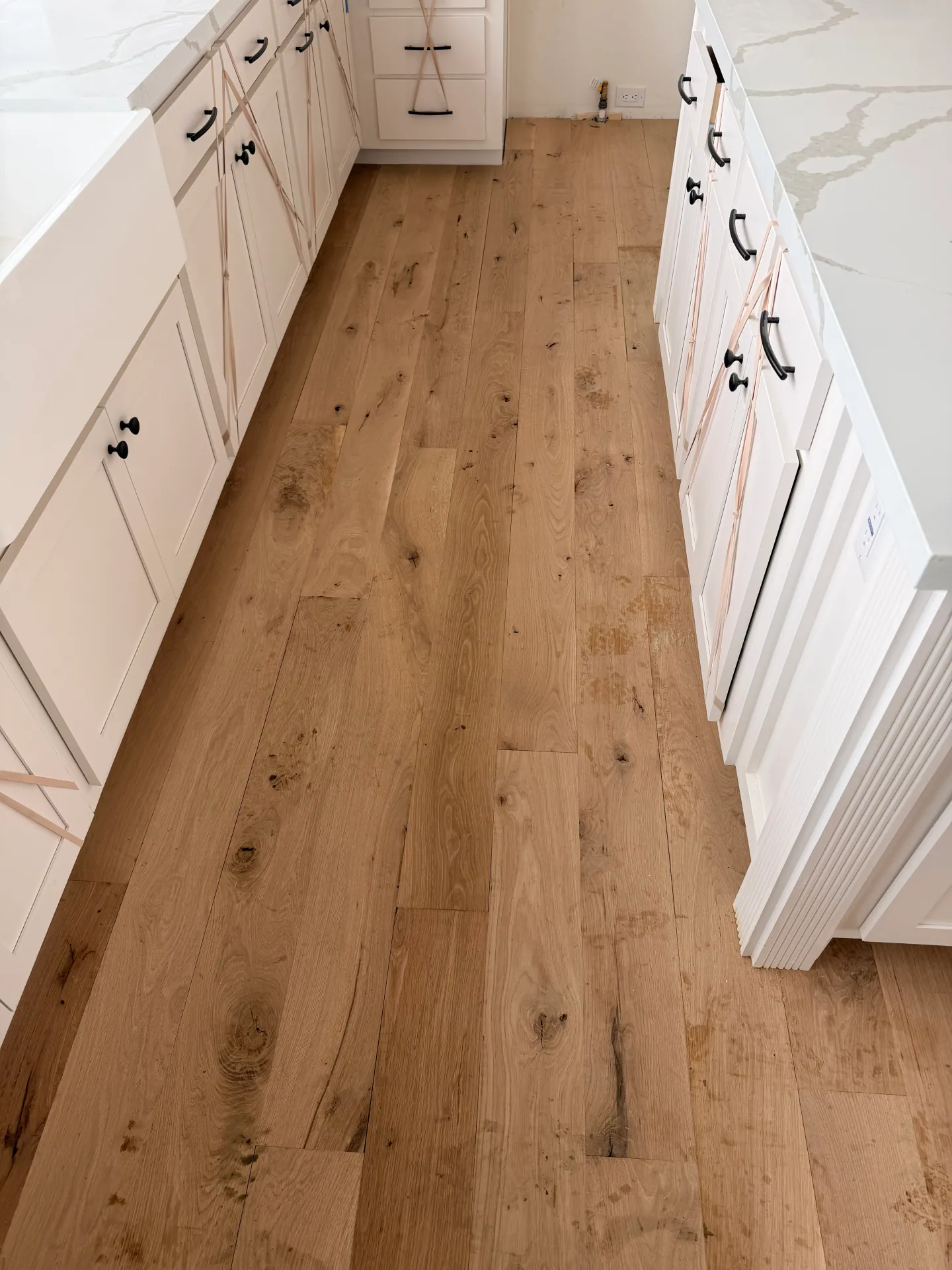
A kitchen floor takes more abuse in a year than a bedroom floor takes in a decade. It gets stood on for hours in the same three square feet, splashed daily, hit with dropped cast iron, and, sooner or later, flooded by a dishwasher or fridge line that let go overnight.
So the question isn’t really “what looks good in a kitchen.” It’s “what survives a kitchen.” Here’s how we think about it for Vancouver and Clark County homes.
The three ways kitchen floors actually fail
Almost every kitchen floor we replace failed one of these three ways:
- Slow water at the appliances. A fridge line or dishwasher weep that drips for months before anyone notices. This is the big one, and it’s what kills laminate and solid hardwood.
- The traffic lane. A visible wear path from the sink to the fridge to the range. Gloss finishes show it first; matte hides it longest.
- Impact. A dropped pan chips tile or dents softer wood species. Nothing is immune, but some floors take it better than others.
Choose for those three, and the aesthetics take care of themselves.
Waterproof luxury vinyl plank: the default for most kitchens
For the majority of Vancouver kitchens, luxury vinyl plank is the right answer. The core is plastic-based, so a dishwasher leak that sits overnight doesn’t swell the planks the way it would ruin a wood-core floor. It’s softer underfoot than tile, which matters when you’re prepping dinner for an hour. And a rigid-core (SPC) plank handles a dropped pot without chipping.
The honest limitation: “waterproof” describes the plank, not the installation. Standing water can still find its way to the subfloor at the perimeter of a floating floor. Wipe up spills; don’t let a leak run for a week.
Porcelain tile: the most durable, with two tradeoffs
Tile is genuinely waterproof, immune to heat, and effectively permanent. If you’re putting in radiant heat, tile is the obvious pairing.
The two tradeoffs are real, though. Tile is hard on your feet and your back over long cooking sessions, and it’s hard on anything you drop, glassware doesn’t survive a fall onto porcelain. Grout also needs sealing and eventually shows in a busy kitchen. Large-format tile with tight joints minimizes the grout you have to live with.
Engineered hardwood: yes, if the kitchen is open to the living room
Open-plan homes create a design problem: a transition strip in the middle of a great room looks like a mistake. Running the same hardwood through the kitchen solves it.
Engineered is the version to use. Its plywood core moves far less with humidity than solid wood, which matters here, where indoor air swings from damp in January to dry in August. Pick a matte or satin sheen, glossy hardwood in a kitchen shows every footprint and every wear lane. Our guide to choosing a hardwood sheen walks through that decision in detail.
What engineered hardwood will not tolerate is a slow leak. If your appliances are older, weigh that honestly.
Laminate: only if you’re realistic about it
Modern water-resistant laminate looks excellent and costs less than LVP. In a low-risk kitchen with newer appliances and a household that wipes spills, it’s a defensible budget choice.
But the core is wood fiber. Standing water at a seam will swell it, and a swollen laminate plank cannot be repaired, it has to be replaced. If the kitchen is the reason you’re re-flooring in the first place, spend the extra dollar or two per square foot on LVP. See our LVP vs. laminate comparison for the full breakdown.
What we do differently around cabinets and appliances
Two details matter more than the material you pick:
- Floating floors stop at the toe kick. LVP and laminate need room to expand. If planks are trapped under a cabinet run or a heavy island, the floor has nowhere to go and it buckles. We plan the layout around this before the first plank goes down.
- Appliances come out. Flooring only up to the front edge of the dishwasher creates a lip that makes future appliance replacement a demolition job. We pull them, floor underneath, and reset.
Budget reality
Kitchens are small, which is good news. Even a premium material choice on 150 to 250 square feet is a manageable number compared with doing a whole floor. That’s often the right place to spend up. Our Vancouver flooring cost guide has current ranges by material, and if the timing is tight, flooring financing can spread it out.
Related reading
- Bathroom flooring in Vancouver, WA
- Waterproof flooring options
- What to expect on installation day
- Kitchen countertops in Vancouver, WA: porcelain slab, tile, quartz and stone
- Kitchen flooring in Gresham, OR: LVP, hardwood or tile for a 1970s to 1990s kitchen
Bring us the room and we’ll bring the samples. Book a free in-home estimate and we’ll look at your appliances, your subfloor, and your cabinet layout before recommending anything.
Frequently asked questions
- What is the best flooring for a kitchen in Vancouver, WA?
- Waterproof luxury vinyl plank is the most forgiving choice for most Vancouver kitchens because the core cannot swell if the dishwasher leaks. Porcelain tile is the most durable and the best match for radiant heat. Engineered hardwood works well if the kitchen is open to hardwood living space and you are willing to wipe spills promptly.
- Can you put hardwood in a kitchen?
- Yes, and it is common in open-plan homes where the kitchen flows into the living area. Engineered hardwood handles the humidity swing better than solid, and a matte or satin finish hides the traffic pattern in front of the sink far better than gloss.
- Should kitchen flooring run under the cabinets?
- For tile, we install up to the cabinet base rather than under it. For floating floors like LVP and laminate, the floor stops at the cabinet toe kick so the planks can expand and contract freely. Running a floating floor under a cabinet run pins it down and causes buckling.
- How long does a kitchen floor replacement take?
- A typical Vancouver kitchen is one to two days for LVP or laminate and two to three days for tile, plus cure time for mortar and grout. Appliances come out and go back the same job, and we handle disconnect and reset coordination as part of the plan.