Flooring Installation in Vancouver, WA: What's Included, How Each Floor Goes Down, and What It Costs
November 23, 2026 · All About Floors NW
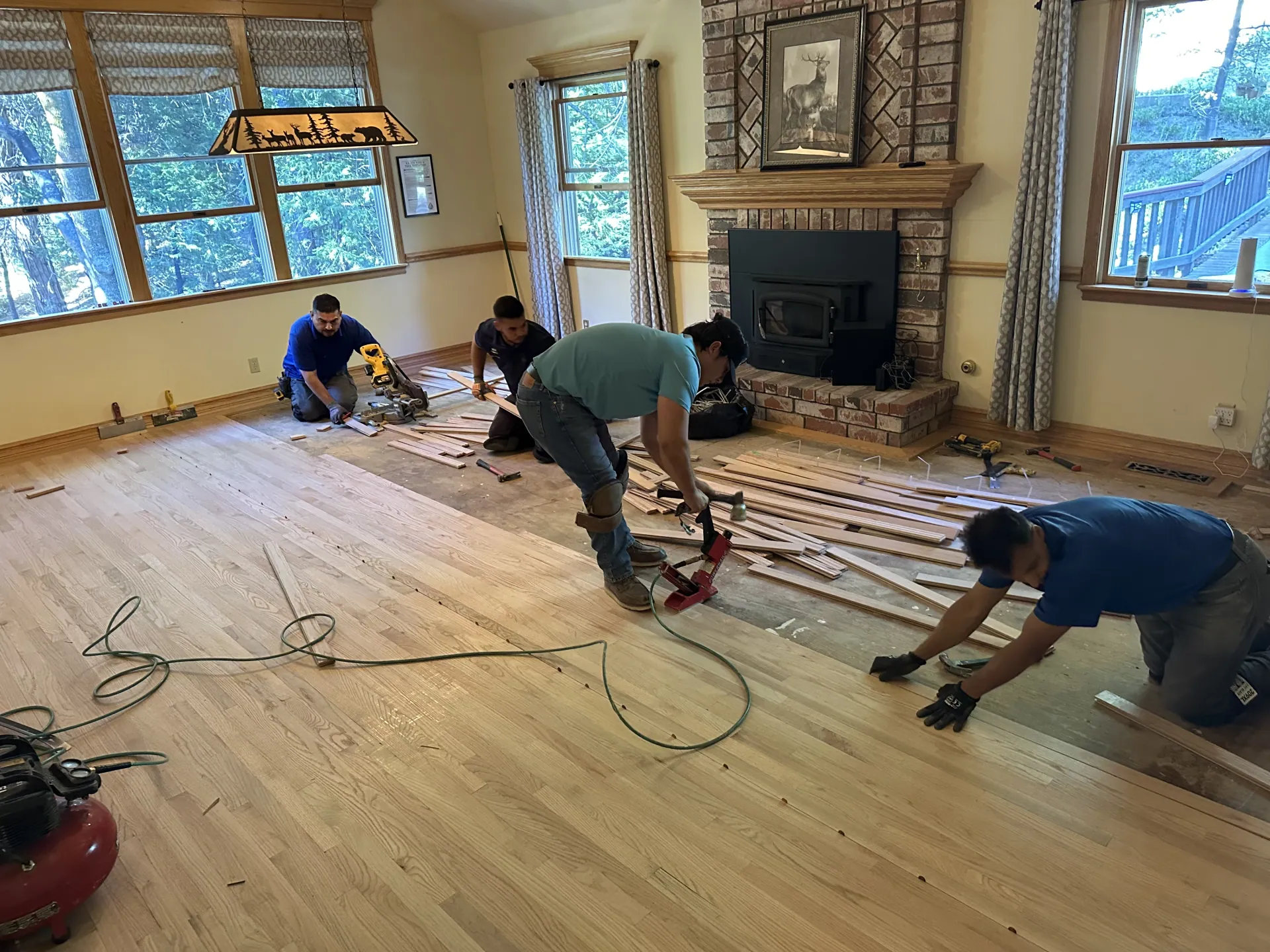
Most people searching for flooring installation in Vancouver have already found a floor they like. What they’re unsure about is everything that happens after: what the quote should include, whether the old floor has to come out, how many days the house will be torn up, and how to tell a good installer from a cheap one.
This guide covers all of that for every floor type we put in. It’s written for homes in Vancouver, the rest of Clark County and the Portland side of the river. For the material-by-material detail, each section links to a deeper guide.
The short version: a fair flooring installation quote is per square foot installed, lists tear-out, prep, underlayment, trim and disposal as separate lines, and comes after someone has measured your rooms and checked your subfloor. If a quote is missing any of those, you’re not comparing like with like.
What “flooring installation” should include
The cheapest number you see is usually the material alone. A complete installation has six parts, and each one belongs on the quote:
- Measure and subfloor check. Someone measures every room, notes doorways, closets and stairs, and checks the floor for flatness, squeaks, soft spots and moisture. On a concrete slab that means a moisture test. Without this step, any price is a guess.
- Furniture moving. Standard household furniture is moved out of the way and put back. Our crews do this at no extra charge.
- Tear-out and disposal. Pulling up carpet and pad, tack strip, old vinyl or laminate, and hauling it away. This is often a separate line, so look for it.
- Subfloor prep. Screwing down squeaks, replacing soft or water-damaged plywood, grinding high spots and filling low spots with patch or self-leveler. Prep is what decides whether a floor lasts. It is also the item most often left off a low bid.
- The installation itself, with the right underlayment, pad or moisture barrier for that floor.
- Finish work. Baseboard or quarter round, transitions to other floors, stair nosing, door undercuts if the new floor is taller, and cleanup.
If you get two quotes and one is a lot lower, check these six lines first. The difference is almost always prep, tear-out or trim that one company priced and the other left out. Our guide to hiring a flooring contractor in Vancouver walks through comparing quotes line by line.
How each type of floor is installed
The method changes with the material, and so does what has to be true about the floor underneath.
| Floor | How it’s installed | What it needs underneath | Typical time, one average room |
|---|---|---|---|
| Carpet | Stretched over pad onto tack strip, seams hot-melt taped | Clean, sound subfloor. Old carpet and pad always come out | Half a day to one day |
| Luxury vinyl plank (LVP) | Floating click-lock, or glue-down in commercial and some kitchens | Very flat (about 3/16” over 10 ft for most brands) | One day |
| Laminate | Floating click-lock over foam underlayment | Flat, plus a vapor barrier on concrete | One day |
| Hardwood | Nail-down over plywood; glue-down or floating over concrete | Dry, flat, moisture-tested subfloor | One to two days, after acclimation |
| Tile | Set in thin-set mortar over cement board or an uncoupling membrane | Stiff, flat subfloor. Large tile needs it flatter still | Two to three days including cure and grout |
Carpet
Carpet installation is mostly about the pad, the stretch and the seams. A power stretcher (not just a knee kicker) is what keeps wall-to-wall carpet from rippling in a year or two. Seams should run away from the main light source and out of walkways. Stairs are priced per step. More on that in carpet installation in Vancouver, WA, and on the products at carpet flooring.
Luxury vinyl plank
Luxury vinyl plank is the most-installed floor in Clark County right now. It’s waterproof, it can float over many existing floors, and a crew can do a whole main floor in two or three days. The catch is flatness. Rigid-core planks bridge small dips but not humps, and an unflat floor shows up as clicking joints and planks that separate. Floating vs. glue-down, expansion gaps and transitions are covered in LVP installation in Vancouver, WA.
Laminate
Laminate installs a lot like LVP but is less forgiving of water and of moisture coming up through concrete. Over a slab or above a crawlspace, the vapor barrier is not optional. Laminate needs its expansion gap at every wall and doorway, which is why it’s trimmed with quarter round or undercut baseboard. Details are in laminate flooring installation.
Hardwood
Solid hardwood is nailed to a plywood or OSB subfloor. Over concrete it’s usually engineered hardwood, glued down or floated. In our climate the step people skip is moisture: the boards need to acclimate and the subfloor needs a moisture reading before a single nail goes in. Homes over a damp crawlspace are where hardwood goes wrong. Nail-down vs. glue-down, acclimation and timelines are in hardwood floor installation in Vancouver, WA.
Tile
Tile is the slowest install because it’s a wet trade. Mortar has to cure before grouting, and grout has to cure before the floor takes real traffic. Large-format tile (anything with a side 15 inches or longer) needs a flatter floor than standard tile. Bathrooms need a waterproofing plan. See tile installation in Vancouver, WA.
What Vancouver and Clark County homes need underneath
The local housing stock decides a lot of the prep work. A few patterns we see again and again:
- Crawlspace homes. Many older houses in central Vancouver, Hazel Dell and Salmon Creek sit over crawlspaces. If the ground isn’t covered with a vapor barrier, moisture works up into the subfloor. That matters most for hardwood and laminate. Check the crawlspace before choosing a floor.
- Slab-on-grade and daylight basements. Newer subdivisions in Battle Ground, Ridgefield and Camas often have slab floors on the ground level. Concrete needs a moisture test and, for most floors, a vapor barrier. Our basement flooring guide covers below-grade floors.
- 1970s to 1990s homes. Subfloors in these homes are often particleboard under the carpet, which swells if it ever got wet and doesn’t hold nails well. Sometimes it has to be replaced or covered with new plywood before hardwood or tile.
- Old sheet vinyl. Sheet vinyl and its adhesive in homes built before the 1980s may contain asbestos. Often the safer and cheaper path is to leave a well-bonded layer in place and float the new floor over it. When it does have to come out, it should be tested first.
- Carpet over hardwood. In older east Vancouver and Portland homes it’s common to pull up carpet and find oak underneath. If it’s in decent shape, refinishing may beat installing anything new. See refinish or replace.
How long flooring installation takes
For planning purposes:
- One room, floating floor or carpet: one day.
- Whole main floor of LVP or laminate (800 to 1,200 sq ft): two to three days.
- Hardwood: add acclimation time before install day, plus one to two days per average room on site.
- Tile: two to three days for a bathroom or entry. Grout cures before heavy use.
- Lead time: stocked products can often be installed within a couple of weeks of the estimate. Special-order lines add shipping time.
You can usually stay in the house. Plan to be out of the rooms being worked on, keep pets away from open doors and saws, and expect some dust and noise. For a day-by-day picture of the process, read what to expect during a professional flooring installation.
What flooring installation costs in Vancouver, WA
These are installed prices (material plus standard labor) per square foot, the same ranges as our full flooring cost guide:
- Carpet: about $3 to $7
- Laminate: about $4 to $9
- Luxury vinyl plank: about $6 to $13
- Hardwood: about $8 to $18
- Tile: about $8 to $20
What pushes a project toward the top of a range: tear-out of glued-down floors, leveling, replacing subfloor, stairs, lots of small rooms and closets, diagonal or herringbone layouts, and moving heavy furniture like pianos. What keeps it low: an open layout, a flat subfloor, a floating floor that can go over what’s there, and doing the whole area at once so there are fewer transitions.
If the total is right but the timing isn’t, look at flooring financing before cutting the project down. A floor that stops at a doorway because the budget ran out costs more to finish later. Our budget guide covers where it’s safe to save.
Finding flooring installers near you: what to check
When you search for installers near you, you’ll see four kinds of results: local flooring stores with their own crews, big-box stores that subcontract installation, shop-at-home franchises, and lead sites that sell your request to whoever pays. Any of them can do a good job. The questions that sort them out are the same:
- Who actually installs the floor? Ask whether the crew works regularly with the company or is a subcontractor found for this one job.
- Is the company registered with Washington L&I? Look it up yourself on the L&I contractor lookup. It takes a minute.
- Did they measure in person and check the subfloor? A quote from a phone call or a photo is a guess.
- Is the quote itemized? Tear-out, prep, underlayment, trim, stairs and disposal should each be visible.
- What does the installation warranty cover, and who do you call? A manufacturer warranty covers the product. The installer’s warranty covers the work. You want both.
- Is there a showroom you can walk into later? If something needs attention a year from now, you want a place, not just a phone number.
More on telling these apart in our guide to choosing a local flooring company.
How flooring installation works with All About Floors NW
We’ve been installing floors in Clark County and the Portland metro since 1999, out of our showroom at 6700 NE 152nd Ave in east Vancouver. Here’s how a project runs:
- Pick your floor. Visit the showroom (Mon–Fri, 9am–6pm) or book an in-home visit and we bring samples to you, so you see them in your own light.
- Free in-home measure. We measure every room, check the subfloor and moisture, and look at transitions and stairs.
- Written quote. Installed price with prep, tear-out, trim and disposal listed out. No surprise add-ons on install day. If we find something unexpected under the old floor, we show you and price it before we fix it.
- Install. Our crews move standard furniture, prep the subfloor, install, trim out and clean up.
- Walkthrough and follow-up. We walk the finished floor with you, and we follow up within 10 days to make sure everything is right. The installation is covered by our installation warranty.
We install carpet, hardwood, luxury vinyl plank, laminate, tile and sheet vinyl across Vancouver, Camas, Washougal, Battle Ground, Ridgefield, Hazel Dell, Salmon Creek, Brush Prairie, La Center, Portland and Gresham. Businesses can see our commercial flooring work.
Ready for a real number? Request a free in-home estimate, call (360) 525-2962, or text us any time.
Related reading
- How much does flooring cost in Vancouver, WA?
- What to expect during a professional flooring installation
- Hiring a flooring contractor in Vancouver, WA: what to verify
- LVP installation in Vancouver, WA: floating vs. glue-down, prep and timeline
- Hardwood floor installation in Vancouver, WA: methods, prep and timeline
- Tile installation in Vancouver, WA: prep, large-format tile and timeline
- Planning a flooring remodel in Clark County
Frequently asked questions
- How much does flooring installation cost in Vancouver, WA?
- Installed (material plus standard labor), carpet runs roughly $3 to $7 per square foot, laminate $4 to $9, luxury vinyl plank $6 to $13, hardwood $8 to $18 and porcelain or ceramic tile $8 to $20. Tear-out, subfloor leveling, stairs and moisture barriers over concrete are what move a quote up or down. A free in-home measure is the only way to get a number for your exact rooms.
- How long does flooring installation take?
- Most single rooms are installed in one day. A whole main floor of LVP, laminate or carpet usually takes two to three days. Hardwood that needs to acclimate, and tile that needs mortar and grout to cure, add time, so a whole-home project typically runs two to five working days.
- Is labor included in the price of flooring?
- It depends on who quotes you. Some stores advertise material-only prices per square foot and add labor, tear-out, underlayment, trim and disposal later. Ask for a written quote that lists every line so you are comparing installed prices, not material prices.
- Can new flooring go over my existing floor?
- Sometimes. Floating LVP and laminate can often go over a single layer of flat, well-bonded sheet vinyl or tile. Carpet and padding always come out first, and hardwood and tile need a clean, solid base. Old sheet vinyl or tile adhesive in homes built before the 1980s may contain asbestos, so it is often better left undisturbed and covered than torn out.
- Do flooring installers move furniture?
- Our crews move standard household furniture at no extra charge. Clear out electronics, fragile items, plants and valuables before install day. Pianos, gun safes, aquariums and fully loaded china cabinets usually need specialty movers.
- How do I find good flooring installers near me?
- Look for a company that measures in your home, gives a written line-item quote, tells you who will actually install the floor, carries an active Washington L&I contractor registration you can look up, and stands behind the installation with a warranty. A local showroom you can walk into after the job is done is worth a lot if anything ever needs attention.