Refinish or Replace? How to Tell If Your Hardwood Is Worth Saving
August 25, 2026 · All About Floors NW
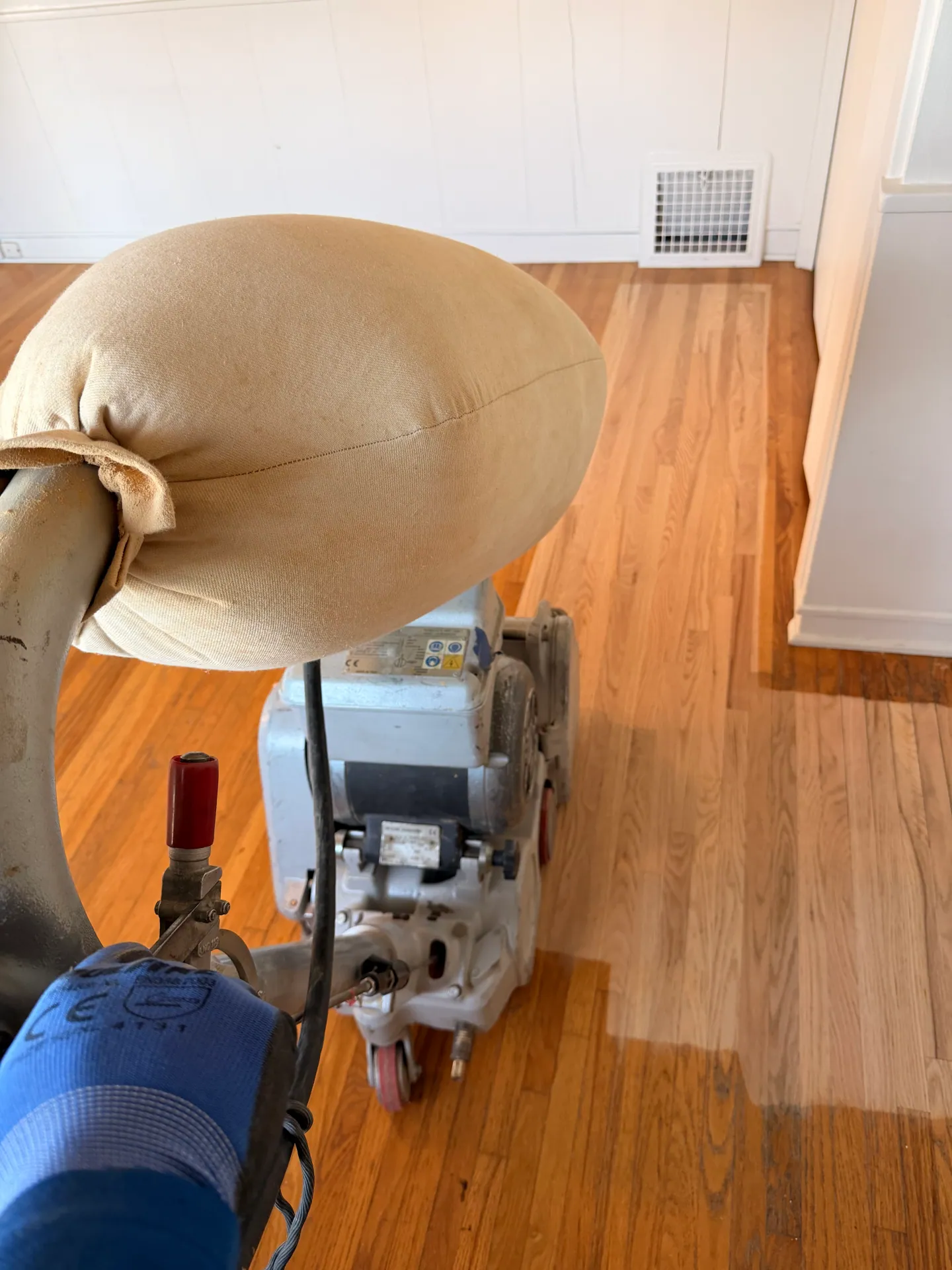
Hardwood is the only floor that gets a second life. Before you spend money replacing yours, it’s worth twenty minutes finding out whether you need to.
We get called for both jobs, so we don’t have a horse in this race. Here’s how we tell the difference.
The test you can do yourself right now
Take the cover off a floor vent, or find an exposed edge at a doorway or closet threshold. You’re looking at the cut end of a plank, which shows you its cross-section.
Find the tongue, the protruding lip on the side of the board. Now measure from the top surface of the plank down to the top of that tongue. That’s your remaining sanding depth.
- About 1/8 inch or more: you have refinishing life left. A full sand removes roughly 1/32 of an inch.
- Noticeably less than 1/8 inch: the floor is near the end. A light screen and recoat may still work, but a full sand risks exposing the tongue and the nails.
- You can see nail heads or the tongue at the surface: that floor has been sanded to the limit. Replacement is the honest answer.
Solid 3/4-inch hardwood gets four to seven refinishes over its life. Most Vancouver homes we walk into have used one or two.
The four things that force a replacement
Sanding depth is the usual answer, but four conditions override it:
1. Water damage that reached the subfloor. Surface cupping from a spill often sands flat. A leak that soaked the subfloor doesn’t, because the problem isn’t the wood you can see. If boards are black, spongy, or lifting, that section is coming out regardless.
2. Structural movement. Widespread gaps, boards that rock underfoot, or a floor that’s separating from the subfloor across a whole room points at the installation or the joists, not the finish.
3. Pet urine that soaked through. This is the one that surprises people. Urine penetrates past the finish into the wood fiber and, in bad cases, into the subfloor. Sanding removes the stain from the top and does nothing about the odor underneath. Affected boards get replaced.
4. An engineered floor with a thin wear layer. If the top veneer is around 1mm, there’s nothing to sand. This is common on the budget engineered products that went into a lot of homes in the 2000s. Our engineered vs. solid hardwood guide explains how to tell what you have.
The stuff that looks fatal and isn’t
People tear out floors that were perfectly savable. The following all sand out:
- Surface scratches, including dog nail damage
- A worn traffic lane through the middle of the room
- Sun fading near windows and dark rectangles where rugs sat
- Cloudy, peeling, or flaking finish, that’s the coating failing, not the wood
- Most surface stains and dents
- A color you hate
That last one matters. A large share of Vancouver refinishing jobs are cosmetic, the floor is structurally fine and the homeowner is done with 2004 orange-toned oak or a glossy finish that shows everything. Sanding to bare wood lets you re-stain to anything, and it lets you change the sheen at the same time.
How the money actually compares
Refinishing wins on cost when the wood is sound, and it isn’t close. You’re paying for labor and finish rather than labor, new material, demolition, and disposal.
Replacement makes sense when the disqualifiers above apply, when you want a different species or a wider plank than what’s down, or when you’re changing material entirely, some homeowners with an aging hardwood floor in a busy household would genuinely be happier on luxury vinyl plank. See our Vancouver flooring cost guide for current ranges on both paths, and financing options if the timing is the issue rather than the decision.
The partial answer nobody offers
There’s a middle path that gets overlooked: refinish the floors that are fine, replace only the room that isn’t.
If the kitchen took a dishwasher leak but the living room and hallway are healthy, we can replace the damaged section, weave new boards into the existing field, and sand the whole floor as one surface. Done well, the repair disappears into the refinish. It costs meaningfully less than doing the whole house and it keeps the original wood everywhere it’s still good.
Related reading
- Hardwood refinishing: the full process
- Hardwood cleaning and maintenance
- Hardwood species and finishes
- If you replace: how hardwood floor installation works
- Hardwood floor staining in Vancouver, WA: the process and timeline
- Wall-to-wall carpet in Vancouver, WA: is it still the right call?
- Hardwood floor restoration: floors under carpet, stains, gaps and cupping
Not sure which category your floor falls into? Book a free in-home estimate. We’ll pull a vent, measure the wear layer, and tell you straight, including when the answer is “leave it alone for another five years.”
Frequently asked questions
- How do I know if my hardwood floor can be refinished?
- Pull a floor vent and look at the cut edge of the board. Measure from the top of the plank down to the top of the tongue. If you have roughly 1/8 inch or more of wood above the tongue, there is sanding life left. Solid hardwood can typically be refinished four to seven times over its life; engineered hardwood depends entirely on the thickness of its wear layer.
- Is refinishing cheaper than replacing hardwood floors?
- Almost always, when the wood is sound. Refinishing avoids the cost of new material, demolition, and disposal, and it keeps the original floor. The exception is a floor with widespread water damage or one that has already been sanded to the limit, where refinishing simply is not an option.
- Can engineered hardwood be refinished?
- Sometimes. It depends on the wear layer, the real wood veneer on top of the plywood core. A 3mm or thicker wear layer can usually take one or two light refinishes. A 1mm wear layer, common on budget engineered products, cannot be sanded at all.
- How long does hardwood refinishing take?
- Plan on three to five days for a main living area, because each coat has to cure before the next goes on. The floors are walkable before they are ready for rugs and heavy furniture, and we will give you the specific timeline for the finish system we use on your floor.